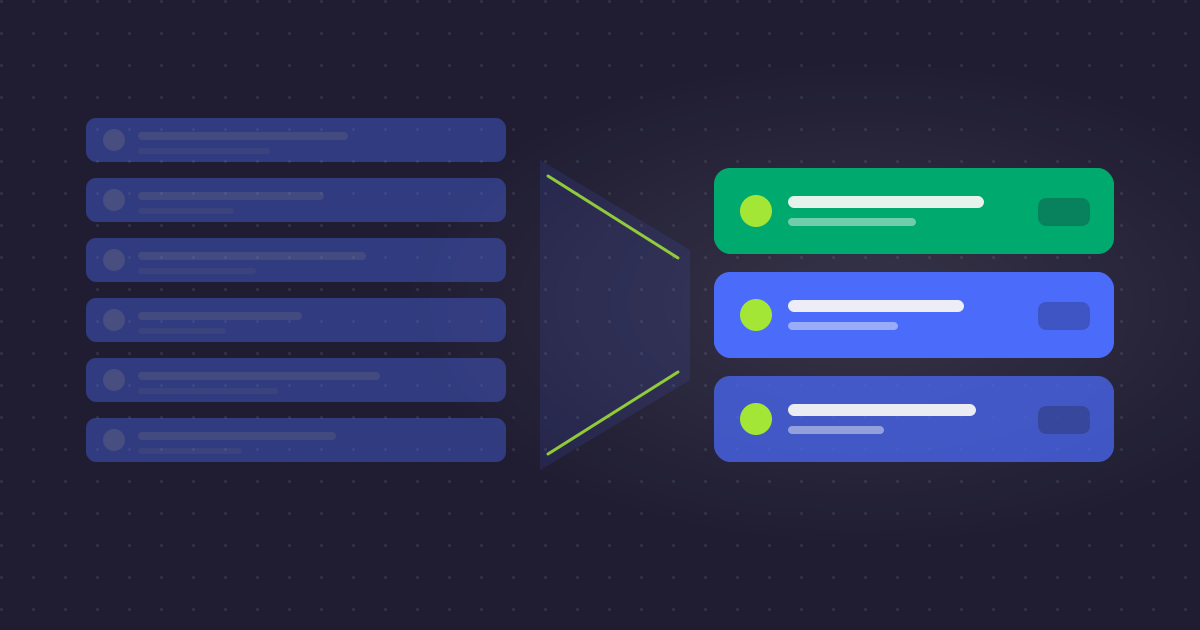
Scaling an online coaching business should feel like progress. But when every new client adds another inbox, dashboard, check-in, and decision, growth can quietly make good coaching harder.
At 8:07 on Monday morning, a coach opens their laptop.
There are 52 athletes on the roster. Six messages came in overnight. Four clients missed a workout. Two athletes still have no check-in. One athlete says her usual weights suddenly feel heavy. Another has logged poor sleep since Thursday. Three people hit personal records.
The coach has plenty of data. What they lack is a clear place to start.
This is where online coaching becomes difficult to manage, not because the coach has forgotten how to write programs, but because the work required to understand the roster has outpaced the roster itself.
That hidden workload is Attention Cost.
Attention Cost is the mental effort required to find the right information, connect the relevant signals, and decide who needs you next. It rises every time you open another client profile, check another message thread, compare another dashboard, or try to remember what changed last week.
And when it keeps rising, the quality of coaching eventually pays for it.
Scaling creates an attention problem
With five or ten clients, you can remember the details. You know who is travelling, who had a difficult week at work, and who mentioned a sore knee after Tuesday's session. If someone misses a workout, you notice. If a check-in feels unusual, you have enough context to understand why.
At 30, 50, or 100 clients, memory stops being a reliable client management system.
The information is still there. It is simply spread across workout logs, progress charts, check-in forms, notes, messages, optional device data, and individual athlete profiles. Before the coach can make a decision, they have to assemble the story.
This is why scaling an online coaching business is not only a capacity problem. It is an attention problem.
You can create another program. You can add another client to your online coaching software. But can you add that client without losing sight of everyone else?
Three signs your Attention Cost is too high
Attention Cost rarely arrives as one obvious failure. It appears in small moments that become normal over time.
1. You review everyone to find the few who need you
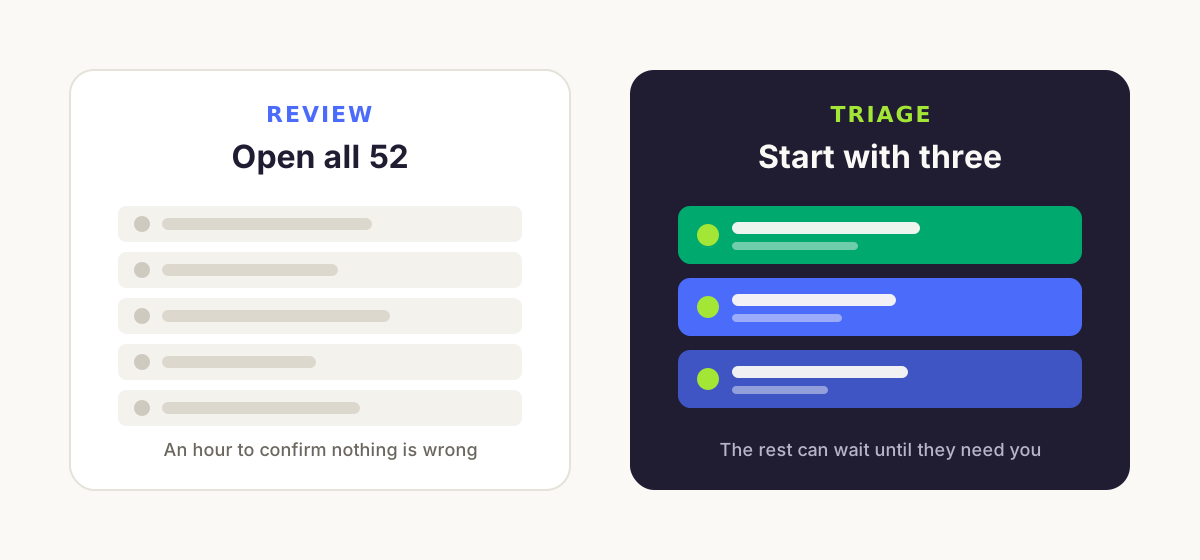
You begin the day by opening client profiles one by one. You check workout completion, recent messages, adherence, progress, and check-in status. Nothing is obviously wrong, but it takes an hour to confirm that.
The problem is not the amount of information. It is the searching required before the information becomes useful.
This also means the loudest client often gets the fastest response. An athlete who sends three messages is hard to miss. The client who quietly stops logging sessions is not.
Good coaching software should give you roster-level visibility: recent activity, missed workouts, unusual check-in scores, changes in workout adherence, and the athletes most likely to need attention. A client list gives you 50 places to look. A coaching-management system should help you narrow them down.
2. The data is available, but the context is not
An athlete's sleep is down. Resting heart rate is higher than usual. Training RPE is rising. Workout completion still looks fine.
Are those separate fluctuations or part of the same pattern? If device data, training history, check-ins, and messages live on different screens, the coach has to make the connection manually.
Connected data is not the same thing as coaching intelligence.
Optional Apple Health or Health Connect data can provide useful context. Sleep, heart rate, steps, and HRV only help when they can be understood alongside the athlete's training and behavior. A stalled lift, rising RPE, and poor sleep mean more together than they do in three separate charts. Good fitness coaching software should shorten the path from observation to decision, not create more dashboards to interpret.
3. Simple coaching decisions create too much administration
A client reports shoulder discomfort. You want to review recent loads, swap two exercises, reduce pressing volume, and leave a note explaining the change.
The coaching decision takes two minutes. The software workflow takes fifteen.
Workout programming features matter: reusable templates, custom exercises, exercise history, sets, reps, tempo, load, rest, RPE, and individual adjustments. But a feature is only valuable if it is easy to use in a real situation.
Can you change one athlete's plan without affecting the library template? Can you see last-time performance when you assign the next session? Can you move from a client message to the relevant program without rebuilding the context?
Every unnecessary click consumes time and focus that could have gone into the athlete. That is Attention Cost too.
More software does not always mean better coaching
It is tempting to solve an overloaded workflow by adding another tool. One app handles workout delivery. Another manages forms. Messages live somewhere else. Wearables have their own dashboards. Notes sit in a document or spreadsheet.
Each tool may work well on its own. The problem appears between them.
Every switch forces the coach to relocate the athlete, remember the question they were trying to answer, and rebuild context. Repeated across dozens of clients, those small resets become a significant part of the day.
This is the difference between workout-delivery software and coaching-management software. One helps you send programs. The other helps you understand people.
At a small scale, that distinction may feel minor. At a large scale, it determines whether growth creates leverage or chaos.
How to measure your Attention Cost
Attention Cost is not a number you will find on a pricing page, but you can see it in your workflow.
For one week, notice what happens before you make a coaching decision. Do you know where to look, or do you search? Is the necessary context together, or do you reconstruct it? Does the system surface exceptions, or do you review everyone to find them?
Pay attention to five signals:
- Time to clarity: How long does it take each morning to understand what is happening across the roster?
- Profiles opened: How many clients do you review simply to confirm that nothing needs action?
- Context switches: How many apps or screens do you visit before replying to a check-in or changing a program?
- Late discoveries: Which missed workouts, adherence changes, recovery issues, or stalled results do you notice later than you would like?
- Repeated work: Which information do you gather or interpret manually every day?
You do not need a perfect score. You need to find where administrative effort is competing with coaching attention.
Test software against the messy reality
A polished product demo will show you the cleanest possible path. A free trial should test the way coaches actually work.
Create sample athletes with different situations: a missed workout, an unusual check-in, declining performance, improving adherence, a new message, and unusual recovery data. Then ask one question: who needs me first?
Next, make a genuine program adjustment. Review exercise history, swap a movement, change volume, and explain the decision to the athlete. Count the screens and repeated steps.
Finally, test the quiet client. Can the software help you find someone whose engagement has slowly declined, even if they have not complained or sent a message?
These scenarios reveal more than a feature checklist. They show whether the platform protects your attention as the roster grows.
Growth should not make coaching less personal
The goal is not to automate coaching judgment. It is to protect it.
Coaches should decide when a program needs to change, when a client needs encouragement, and when an unusual signal deserves a conversation. Online coaching software should reduce the searching, sorting, and remembering that happen before those decisions.
A short daily check-in is one way to shrink that search. The right system also helps you create training programs, manage clients, monitor adherence, track progress, handle check-ins, interpret optional device data, and communicate with context, without losing sight of the roster as a whole.
Because when coaching becomes too much to manage, the problem is rarely a lack of information.
It is the cost of finding out what matters.
TrainerX is built to lower that cost. Coaches open the Morning Brief to a roster already sorted by who needs attention, with workout completion, session feedback, daily check-ins, and optional Apple Health or Health Connect context in the same picture.
When the searching starts eating your mornings, see how TrainerX runs the loop for you: athlete management, roster triage, and programming in one place, with a 14-day free trial.